
Flooding rarely occurs from a single source. During major storm events, heavy rainfall, riverine flooding, and coastal storm surge can occur simultaneously, creating compound flooding conditions that are more complex—and potentially more damaging—than any individual flood process.
Understanding how these processes interact is critical to accurately estimating flood hazards and supporting resilient infrastructure planning. Yet, traditional modeling approaches often evaluate individual flood sources separately and then combine the results. While useful for certain applications, this approach may not fully represent the interactions occurring between rainfall, rivers, and coastal systems during an extreme event.
DynamicSolutions | DCCM recently collaborated with the U.S. Army Engineer Research and Development Center (ERDC) to advance a more integrated approach to compound flood modeling.
Capturing Multiple Flood Processes in a Single Model
The project involved implementing an advanced version of the Adaptive Hydraulics Model (AdH) capable of simulating the combined impacts of heavy rainfall, riverine flooding, and coastal storm surge within a single modeling framework.
By representing these processes together, the model can account for interactions that may be missed when individual flood sources are modeled independently. This provides a more integrated representation of how water moves through interconnected coastal and riverine environments during major storm events.
The approach is particularly valuable in areas where rainfall-driven runoff, river flows, and coastal water levels can influence one another and contribute collectively to flood conditions.
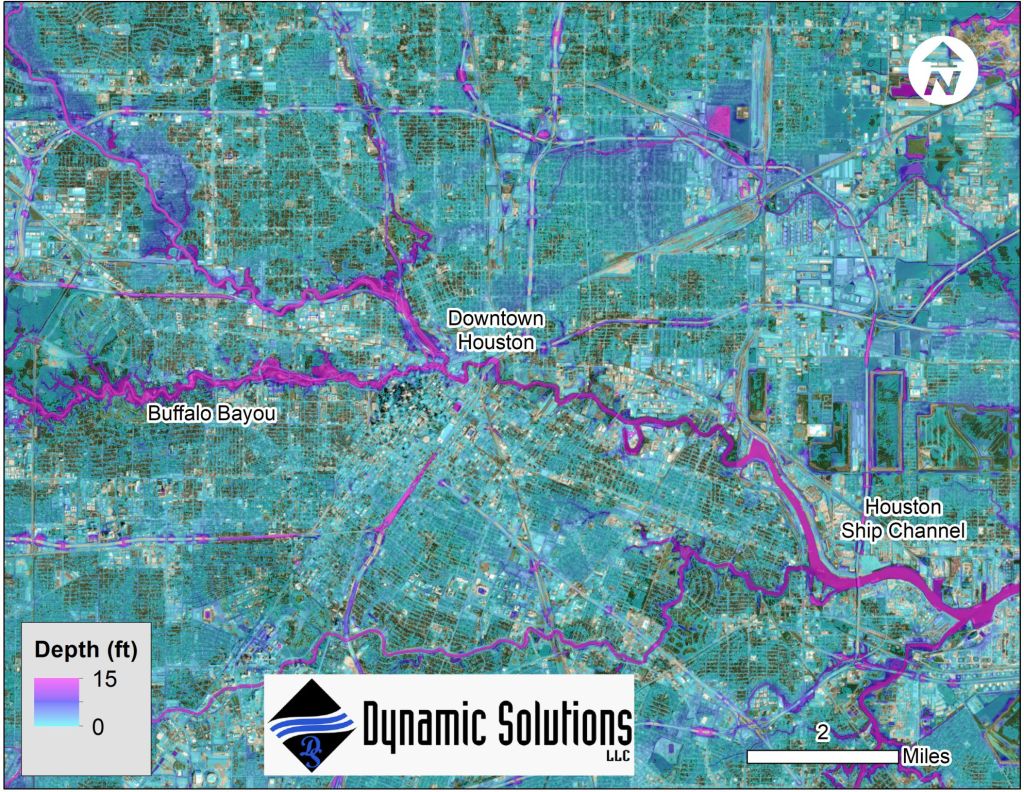
Applying the Model to Hurricane Harvey
To demonstrate the advanced modeling capabilities, DynamicSolutions | DCCM and ERDC applied the model to Hurricane Harvey in Galveston Bay and Harris County, Texas.
Hurricane Harvey provided an opportunity to evaluate a complex event involving multiple sources of flooding across a large coastal and urban environment. Using the advanced version of AdH, the team simulated the combined influence of heavy rainfall, riverine flooding, and coastal storm surge within a single model.
Rather than treating these mechanisms as isolated processes, the integrated approach allowed their interactions to be represented directly within the simulation.
Improving Our Understanding of Compound Flood Risk
As communities plan for extreme weather and changing flood risks, understanding compound flooding is increasingly important. Flood hazard assessments that better represent the interaction among multiple flood sources can provide engineers, planners, and public agencies with more complete information for evaluating vulnerabilities and planning infrastructure improvements.
Integrated modeling approaches such as this can help advance the way complex flood events are analyzed—providing a more comprehensive picture of how rainfall, rivers, and coastal systems work together during extreme conditions.
DynamicSolutions | DCCM brings specialized expertise in hydrodynamic modeling and water resources engineering to help public agencies and project partners better understand complex flood processes and evaluate infrastructure challenges.
Explore DynamicSolutions | DCCM’s services or connect with our team to learn how our modeling and water resources expertise can support flood risk assessment, resilient infrastructure planning, and complex water resources projects.
