Transportation

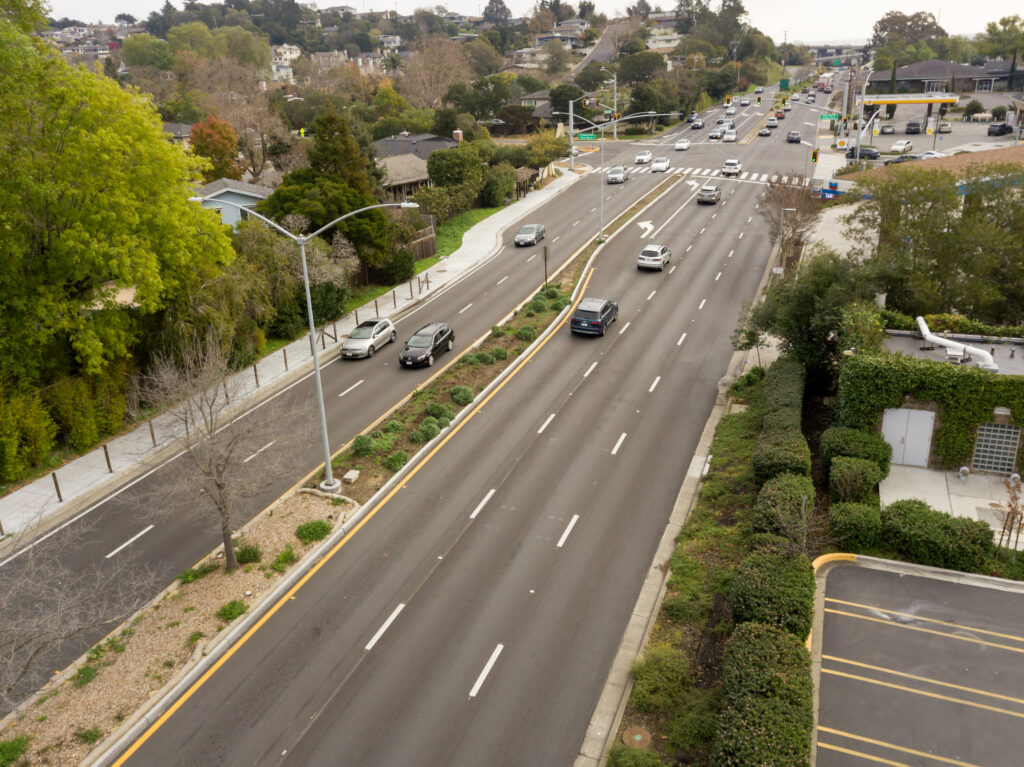
Aerial view looking straight down at a multilane highway with a new crosswalk intersecting both directions of travel lanes

FM 2818 (Harvey Mitchell Parkway) Improvements

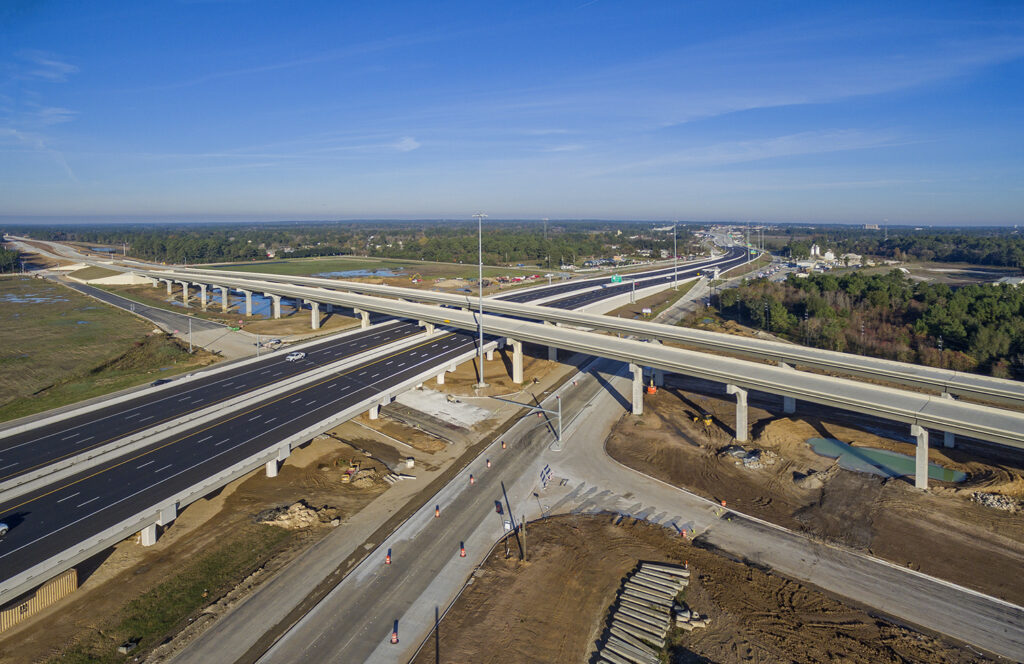
FM 2818 (Harvey Mitchell Parkway) Improvements College Station, Texas The FM 2818 (Harvey Mitchell Parkway) project in College Station is a story of innovation, collaboration, and technical excellence. DCCM led the team that worked closely with the City of College Station, TxDOT, Texas A&M University, and Easterwood Airport to address the region’s rapid growth and evolving transportation needs. Our journey began with a comprehensive corridor study and traffic analysis, which revealed that traditional intersection designs would not provide the necessary capacity or operational improvements. In response, we expanded our analysis to include six additional alternatives and ultimately selected an innovative “superstreet” (Restricted Crossing U-turn) design. This approach reduced signal phases at intersections, improved traffic flow, and provided flexibility for future upgrades to a controlled access facility. Our scope included data collection, accident and traffic analysis, environmental documentation, public involvement, identification of right-of-way (ROW) and easements, utility coordination, and topographic surveying. We also managed a team of eight subconsultants for specialized analyses and design tasks. We completed both the schematic and PS&E phases for FM 2818, developing a geometric design schematic from Wellborn Road to F&B Road, and seamlessly transitioning into detailed construction documents. The final schematic design was coordinated with the parallel PS&E design team, enabling construction documents to reach 60% design before schematic finalization. This efficient transition was made possible by keeping most of the same key staff and maintaining a strong project management plan throughout both phases. One of the most significant challenges was the presence of a major underground electric duct bank that conflicted with the proposed curb line and storm sewers. By conducting precise SUE QL-A potholing and collaborating with the city and TxDOT, we developed a solution that allowed the duct bank to remain in place while relocating the storm sewer, avoiding major disruptions and keeping the project on schedule. Another challenge arose when a new overpass at Jones-Butler Road was added late in the design process. Our team quickly adapted, revising schedules and resources to incorporate the new structure without impacting the letting date. Environmental considerations were also paramount. White Creek, which runs parallel to the corridor, required careful coordination to minimize impacts to the floodplain and wetlands. Through detailed grading, innovative barrier design, and close collaboration with regulatory agencies, we kept wetland impacts below permitting thresholds and avoided additional ROW acquisition. The FM 2818 project is now under construction. The result is a safer, more efficient, and future-ready corridor that supports the continued growth of College Station and the surrounding community. Traffic Analysis/Corridor Study Services DCCM performed a corridor study for FM 2818 from George Bush Drive to Wellborn Road. The study examined various alternatives, including many different intersection configurations. Ultimately, the conventional intersection designs failed to provide adequate operations. As a result, the superstreet concept was proposed and evaluated as a potential solution for the corridor. This provided the opportunity to reduce signal phases at intersections while maintaining the flexibility to upgrade the corridor to a controlled-access facility in the future should the need arise. Responsiveness: The original scope included an analysis of three options for access management along the corridor, none of which provided adequate capacity. To keep the project on schedule, the DCCM team worked with the City of College Station and TxDOT to identify and analyze six more options before the change order was processed. The innovative intersection used in the final design was one of these six additional options. Surveying Services During the S&E phase, DCCM provided a comprehensive topographic survey on this City of College Station/TxDOT street design project. The route was a 1.8-mile section of the existing state highway roadway. The extra width of the ROW created an unusually large, 80-acre project area, with several acres of native trees and brush. Using baseline survey points and information from the early 1970s, the ROW lines were accurately fitted to the topographic survey. Additionally, Baseline | DCCM had surveyed utility easements along the highway over 15 years prior, before any of the adjoining apartment complexes were developed. Schematic Design Services DCCM developed a geometric design schematic for FM 2818 from Wellborn Road to George Bush Drive. The project scope included conceptual and schematic design, data collection, accident and traffic analysis, conceptual design, schematic design, environmental documentation, public involvement, ROW/easement identification, utility coordination, project management, and topographic surveying. The initial scope included analyzing three design-year alternatives, developing a conceptual schematic for each, and developing the selected alternative through schematic design. Based on the results of the traffic analysis/conceptual design and meetings with City of College Station and TxDOT staff, it was determined that the three design-year alternatives would not adequately address growth issues along the project corridor; therefore, six additional alternatives were analyzed. Based on the traffic analysis and input from the City and TxDOT, a “super street” option was selected and developed through schematic design. SUE Services Under the SUE department’s TxDOT contract, the Bryan District requested that SUE QL-B designation be performed for their 3.2-mile FM 2818 Improvement project. More than 265,000 linear feet of utilities were identified on the project, resulting in a utility map that revealed numerous critical conflicts with the proposed roadway improvements. The designers and utility coordinators asked for 24 SUE QL-A test holes. All test holes were completed, the SUE QL-B designation and the conflicts it revealed were validated, and the designation was assigned. An additional SUE QL-B was requested for the downside streets to fully understand the utility impact. This project faced challenges, including complex traffic control and Texas A&M mowing the TxDOT ROW before each home football game. It was critical to complete the survey work each week before the Friday afternoon mowers arrived. At a Glance 40% Reduction in Corridor Travel Times $57.6 million Construction Cost Markets Transportation Environmental Services Transportation Surveying Utilities

SH 249 (Tomball Tollway), Phases I and II

SH 249 (Tomball Tollway), Phases I and II Tomball and Montgomery County, Texas DCCM was contracted by the Harris County Toll Road Authority (HCTRA) as the Program Management Consultant (PMC) for the design and management of both preliminary and final project designs, as well as construction management and inspection services for Phase II. We developed a project feasibility assessment, which resulted in the SH 249 (Tomball Tollway), Phases I and II engineering feasibility report, and served as the basis for the final design. On its first day of operation, eager toll users doubled the projected 17,000 daily toll transactions, cutting traffic on the existing frontage road in half. Funded entirely with toll road revenue paid by drivers who choose to use the Harris County toll road system, the final construction will extend the toll road into Montgomery and Grimes Counties to SH 105, streamlining trips to and from rapidly growing Grimes County and College Station. Phase I: Spring Cypress Road to FM 2920 This project provided travelers with four main lanes in each direction and was constructed between the existing TxDOT northbound and southbound non-tolled frontage roads. As PMC for HCTRA, DCCM completed an aggressive 9-month design program to deliver plans, specifications, and estimates (PS&E) for HCTRA to bid and construct this phase. DCCM provided leadership, schedule adherence, quality assurance, and oversight to 17 consultants, completing the PS&E for four new toll lanes in each direction along a 6-mile stretch of SH 249, adding five new bridges, retaining walls, and a drainage system that mitigates flooding. Drivers may now bypass seven stoplights while the frontage roads remain toll-free. All milestone submittals were met on time, and the project was constructed in only 16 months and under three construction contracts. Phase I was open to traffic in April 2015 and is exceeding all revenue forecasts.  Phase II: FM 2920 to Spring Creek (Harris/Montgomery County line) Design preparations for Phase II began in October 2014 with design revisions to the TxDOT 2006 SH 249 Schematic. As in Phase I, DCCM was the PMC for the design of four-lane toll lanes in each direction, adding three-lane frontage roads on both north- and southbound approaches, five major bridges, flood-mitigating storm sewer detention, a collegiate practice field, and equestrian and bike trails. Services also included computing cut-and-fill quantities for roadway sections, concrete and reinforcement steel quantities for bridge deck pours, and payments for such pours on the contractor’s pay estimate. DCCM monitored the roadway excavation, subgrade preparation, concrete milling, embankment placement for abutments, installation of drill shaft and foundations, concrete beam placement, asphalt pavement placement, bent footings, column, cap pours, reinforced earth walls, 18- to 36-inch reinforced concrete pipes, and various concrete box culverts. Our team oversaw construction management and inspection services for this segment of the project.  Phases I and II of the SH 249 (Tomball Tollway) project included environmental investigations and permitting, survey/ROW mapping, utility identification and assessment, subsurface utility engineering (SUE), and hydrologic and hydraulic (H&H) modeling and detention pond design. DCCM also provided construction phase services for Phase II and the direct connectors at SH 99 (Grand Parkway). Mainlanes, Phase I, Section 1 – Montgomery County MCTRA selected DCCM to prepare PS&E for mainlane and ramp construction for a 0.4-mile section of tollway north of Tomball, Texas. The project scope included roadway geometric design, traffic control plans, removal plans, drainage plans with both open and closed systems, SWPPP, cross-sections, general notes, specifications, and construction cost estimates. The DCCM team coordinated with both adjacent designers on the Montgomery County segment and with the design and construction teams of the Harris County segment to the south to deliver a synchronized product that minimized impacts to travelers and adjacent property owners and reduced overall project costs. At a Glance $101 million Phase I Construction Cost $99 million Phase II Construction Cost Markets Transportation Services Transportation Utilities Surveying Water & Wastewater

West Terre Haute Trail

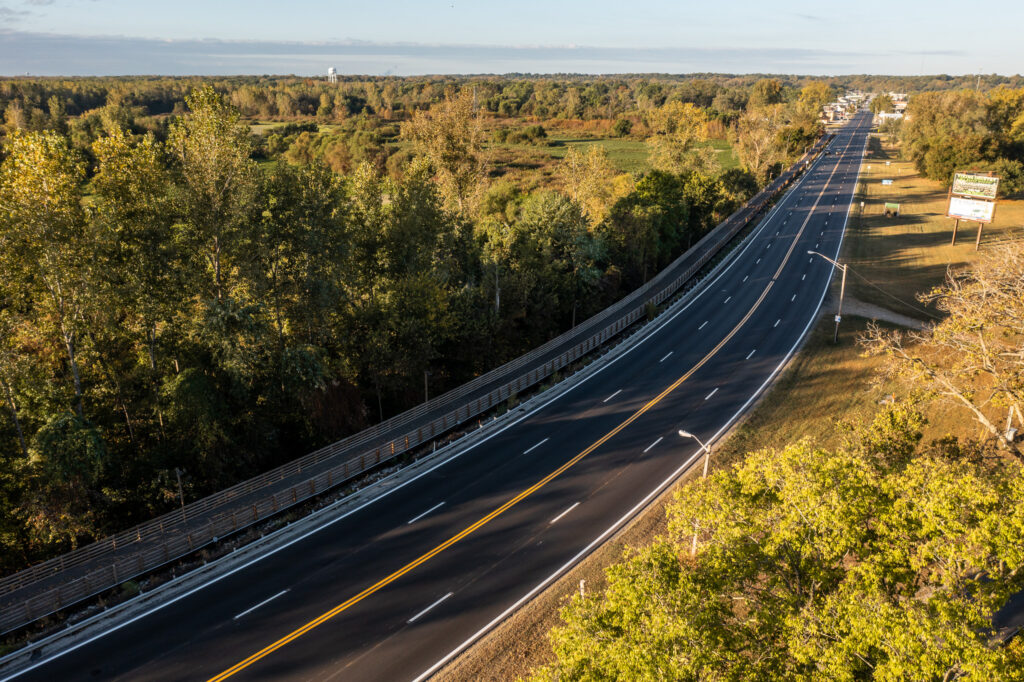
West Terre Haute Trail West Terre Haute, IN This one-mile-long pedestrian trail is located along the south side of US 150 in West Terre Haute, beginning at Sumner Avenue and extending east to Schley Place. The goal of this project was to improve pedestrian safety, increase connectivity, reduce congestion, and improve air quality.  Prior to construction, pedestrians were forced to walk along the narrow US 150 shoulder beside traffic or behind the guardrail adjacent to the steep side slope, creating a dangerous and restricted walking path. With this project, West Terre Haute was able to provide an alternate route for commuting individuals, families, and those needing to access jobs without vehicles. This trail and bridge improved safety for pedestrians and vehicular travelers amidst increased US 150 traffic.  At a Glance 1 Mile Project Size $6.6M Project Cost ACEC State Finalist Project Award Markets Transportation Environmental Services Transportation

Brays Bayou Federal Flood Control, Multiple Channel Improvements, and Bridge Replacements

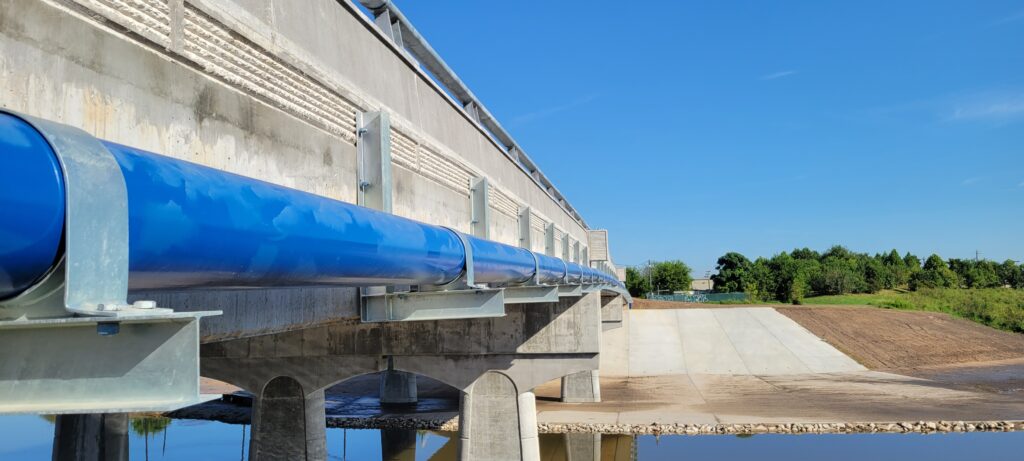
Brays Bayou Federal Flood Control, Multiple Channel Improvements, and Bridge Replacements Houston, Texas DCCM was contracted by HCFCD to provide engineering services for three separate projects for Brays Bayou. Channel Modifications, Discrete Segment 109 – DCCM evaluated the impact of the proposed channel widening on the existing foundation of eight bridges. DCCM also designed soil-nail and gravity retaining walls to protect the bridge abutments and to stabilize the bayou banks. Additional services included preparing a structural analysis of the proposed walls per HCFCD criteria, PS&E, force mains relocation design, relocation and replacement of existing storm sewer flap gate boxes, and an updated evaluation of the previous IH 610 bridge engineering report. Services also included an alternative final design, evaluation of existing bridge foundations’ capacity, and a recommendation on soil excavation impact.  Telephone Road, Lawndale Street, South 75th Street, and Almeda Road Bridge Replacements – DCCM provided preliminary and final design and bid and construction phase services for the replacement of the four bridges. DCCM investigated the site, reviewed record drawings and existing utilities, and conducted a topographic survey of the existing channel and bridges to supplement the data. DCCM assisted with the coordination of lane configurations and sidewalk widths to determine typical bridge sections and prepared exhibits showing alternatives for each bridge. DCCM prepared TCPs, local drainage design, SWPPP, a drainage area map, hydraulic calculations, and drainage standards. Construction cost: $23 million Stella Link Road and Ardmore Street Bridge Replacements – DCCM provided the design, coordination, scheduling, and PS&E for the replacement of the existing Ardmore Street bridge and addition of a new span to the Stella Link Road bridge. The project increased the hydraulic capacity of Brays Bayou by expanding the cross-sectional area under the bridges. The new bridge at Ardmore Street provided a U-turn, wider lanes, and sidewalks for community connectivity. The project included a compressed schedule to meet federal funding requirements, environmental issues, and utility coordination due to gas lines, storm sewer, gravity and force main sanitary sewers, and electrical and water lines on the bridges.  At a Glance $11 million Discrete Segment 109 Construction Cost $23 million Telephone Road, Lawndale Street, South 75th Street, and Almeda Road Bridge Replacements Construction Cost $23 million Stella Link Road and Ardmore Street Bridge Replacements Construction Cost Markets Transportation Services Transportation

Panther Parkway

Panther Parkway

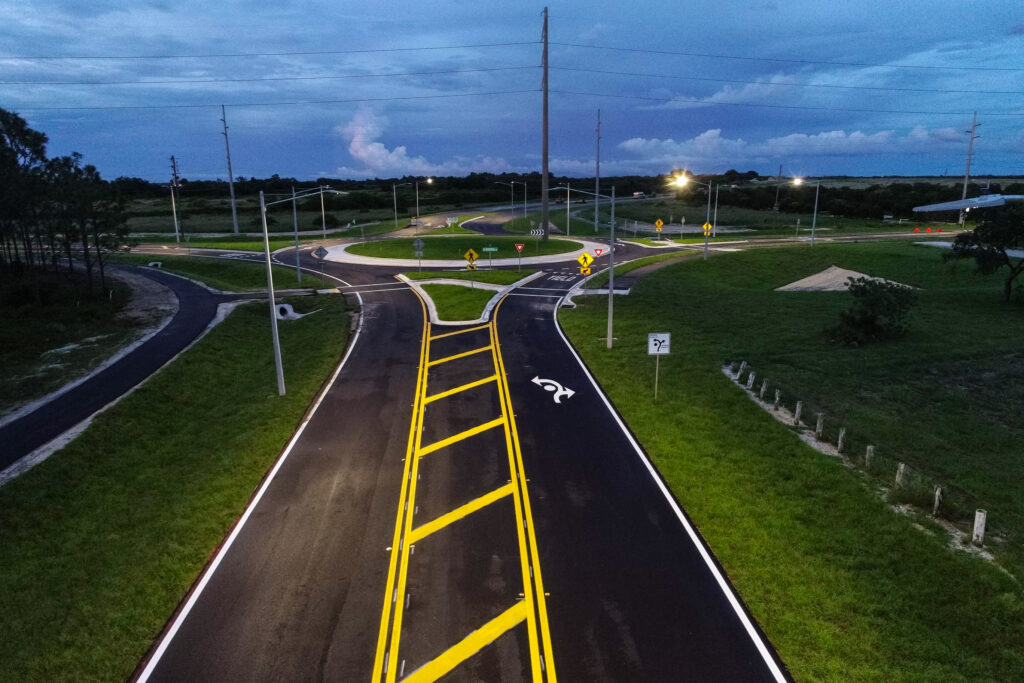
Panther Parkway Sebring, FL PHASE I – In fall 2001, DCCM completed the design for widening approximately one mile of Fairmount Drive from a two-lane local road to a five-lane major collector with sidewalks. Construction was completed by the end of 2002 at a cost of $500,000. PHASE II – DCCM supported the County by designing highway lighting and signalization for six intersections and preparing the design and permitting for six stormwater retention ponds along the two-mile route. PHASE III – In January 2017, DCCM contracted with the Highlands County Board of County Commissioners to modify the design of a 4.3-mile segment of Sebring Parkway Phase III between Sebring and Avon Park. The original design and permit, completed by others, proved cost-prohibitive and jeopardized an FDOT CIGP Grant. Leveraging our expertise in stormwater permitting, DCCM redesigned the entire roadway and modified the Environmental Resource Permit, managing $3.2M in FDOT funding. Construction, estimated at $8M, began in March 2018. By August 2019, the north-end connection to the Memorial Drive Roundabout was completed, and the Sebring Roundabout (formerly Panther Parkway) on the south end was finished by year-end 2019. At a Glance 4.3 Miles Project Size $10M Project Cost Markets Transportation Services Transportation

Scroll to Top